Building a Better Billboard Website · Article 2 of 8
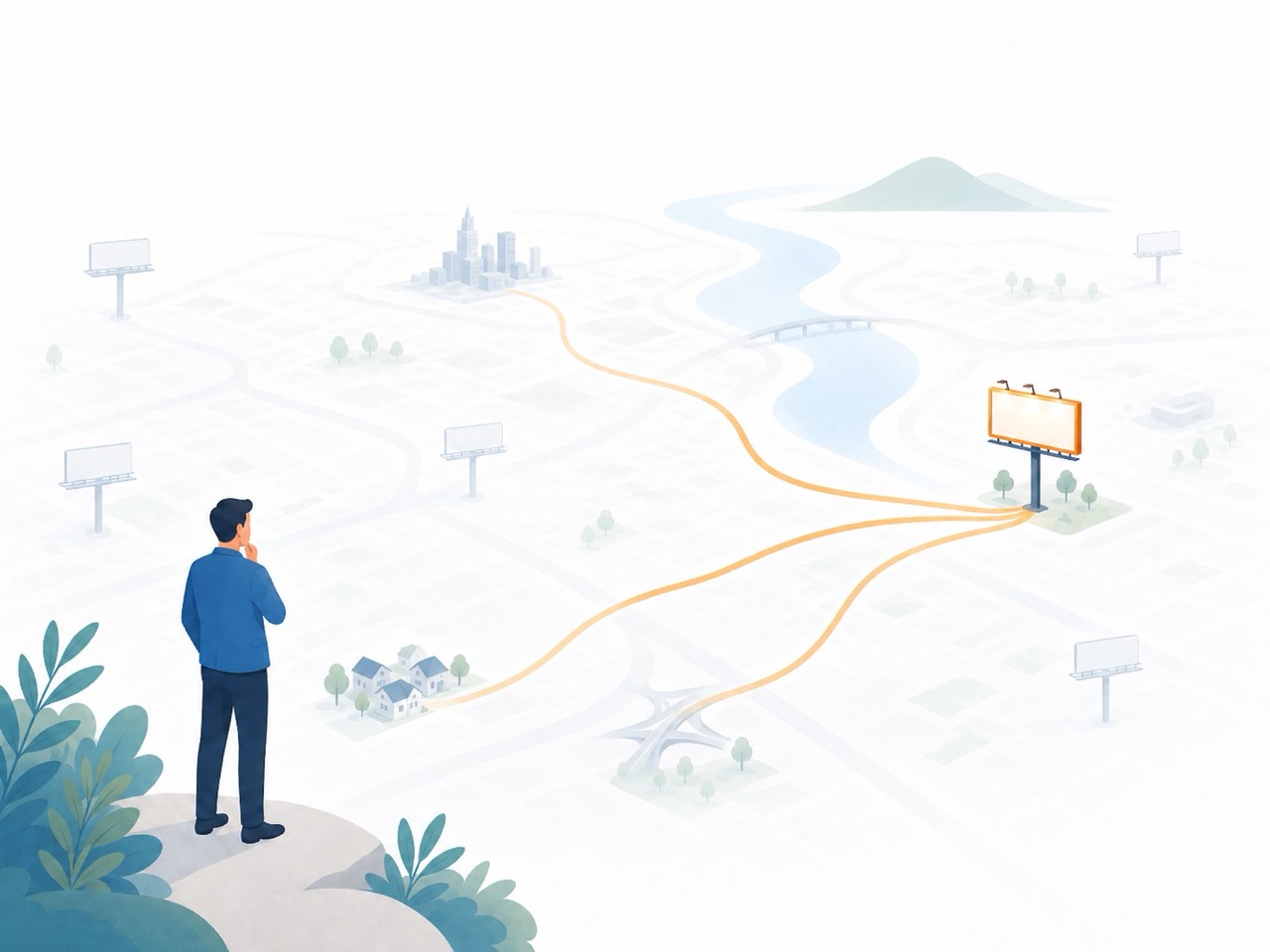
You can own hundreds of billboards without giving Google a clear picture of where any of them are.
At first, that sounds impossible. The structures are standing beside highways. Drivers pass them every day. Your sales team knows every location by memory. Your inventory system tracks every face, and your website may even mention that you operate in dozens of markets.
None of that necessarily means Google understands your inventory.
Owning a billboard and publishing a billboard are two different things.
That distinction is easy to miss because billboard operators naturally think about physical assets. Search engines only understand digital representations of those assets.
A billboard exists in the real world. Google only knows what your website represents.
In the previous article, we looked at why a billboard website should help advertisers understand your inventory. This article takes the next step.
Google doesn’t rank inventory.
Google ranks pages.
A Billboard Can Exist Without Being Discoverable
Imagine two billboard companies with nearly identical inventory.
Both own digital displays in Greenville. Both have excellent locations. Both have experienced sales teams. Both have websites.
From the road, there is very little difference between them. From Google’s perspective, there may be a tremendous difference.
Google doesn’t compare physical inventory. It compares web pages.
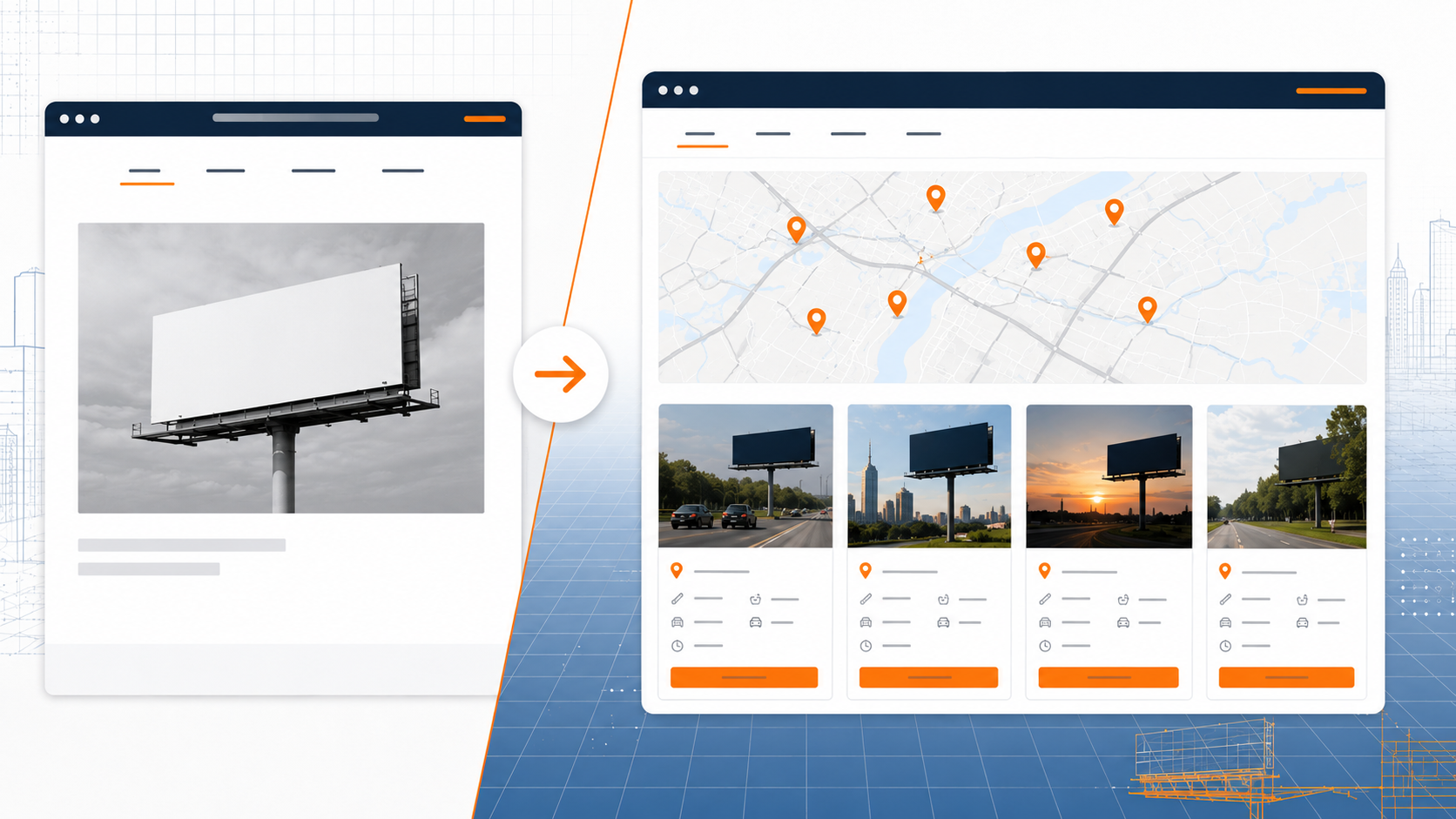
If one company publishes organized pages describing its markets, cities, highways, and billboard locations, Google has something meaningful to discover and understand.
If the other company keeps most of its inventory inside a searchable application, a downloadable PDF, or a single generic “Locations” page, Google has far less information to work with.
The difference is not the billboards. It’s how those billboards are represented online.
That is why simply owning inventory does not automatically make it discoverable.
Publishing Inventory Is Different from Storing Inventory
Most billboard companies already have excellent inventory records.
They know every face, every size, every illumination type, every lease, every availability date, every photograph. Those records are essential for running the business.
But running the business and publishing the business are different jobs.
A filing cabinet can hold thousands of perfectly organized documents. That does not make it a library.
A library is organized so people can discover information.
The same idea applies to billboard inventory.
Your inventory system may be exceptionally organized for your sales team and operations staff. Your website serves a different audience. Its job isn’t to manage inventory. Its job is to help advertisers understand it.
That doesn’t mean exposing every internal detail. It means publishing the information advertisers actually need in a way that’s easy to navigate, easy to understand, and easy to discover.
When you organize information for people, search engines benefit from that organization too.
Owning inventory isn’t the same as publishing inventory.
Google Understands Pages, Not Databases
It’s easy to assume that if your inventory is somewhere on your website, Google understands it.
It may.
But not simply because the inventory exists somewhere on the site.
Search engines don’t look at a website the way your sales team does. They understand pages—the information on those pages, how they’re organized, and how they connect to one another.
Google can’t rank a billboard. It can rank a page that explains that billboard.
The same is true for a market, a highway corridor, or even a spreadsheet full of inventory. Google doesn’t understand the file itself. It understands the pages you publish from it.
That’s the difference between storing information and publishing it.
The Page Explains the Billboard
Think about one billboard.
Perhaps it is a digital face along US-29 in Greenville.
In the real world, it exists whether your website mentions it or not. Your sales team knows where it is. Your installers know where it is. Your accounting system knows where it is.
The page does not create the billboard.
The page explains the billboard.
It gives the location a title. It provides photographs. It describes the market and the roadway. It connects that location to the surrounding geography.
Most importantly, it gives both people and search engines enough context to understand what the billboard actually is.
The better the representation, the easier it becomes to discover.
Structure Gives Context
An individual billboard page can answer questions about one location. But a well-structured website does something bigger. It helps people understand how all of your inventory fits together.
Think about how advertisers actually plan a campaign.
They don’t usually begin with a specific billboard. They begin with a city, a market, a highway, or a region they want to reach. From there, they narrow their options until they find the locations that make sense.
Your website should support that same process.
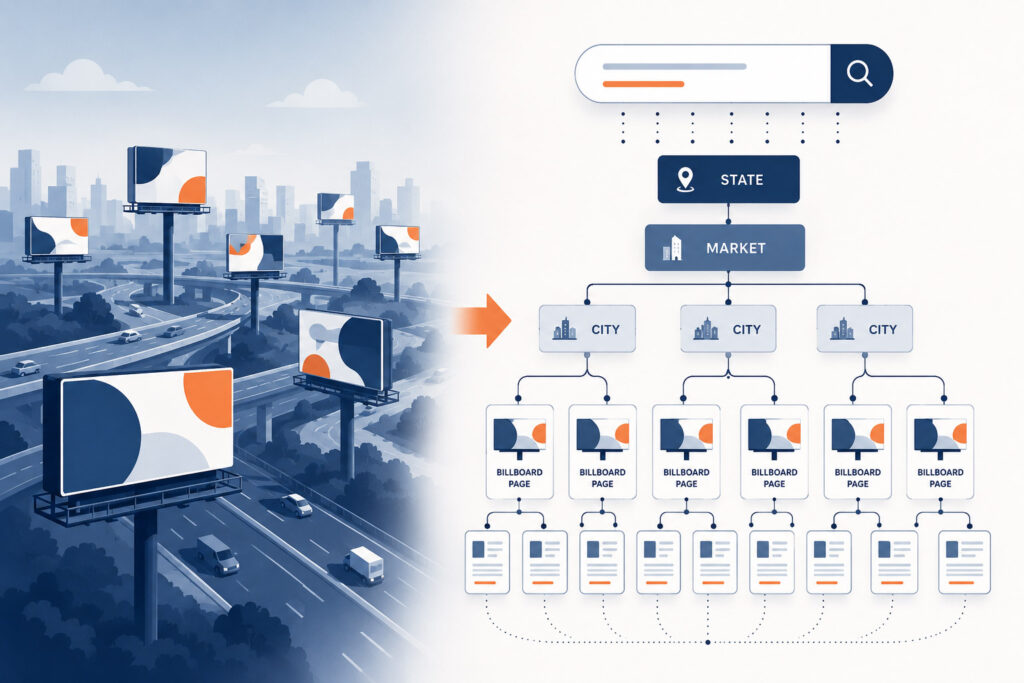
A market page naturally leads to city pages. City pages lead to individual billboard locations. A highway page may connect locations across several communities. Every page adds context to the pages around it.
That context helps visitors move naturally through your inventory instead of starting over with every search. And it also gives search engines a much clearer picture of how your inventory is organized.
The benefit isn’t just that Google likes a particular website structure. It’s also that the structure already makes sense for the people using it.
When a website reflects the way advertisers think about geography, search engines usually find it easier to understand as well.
Ask a Different Question
Many operators ask, “Can visitors search our inventory?”
That is a reasonable question.
A better question is, “Can Google understand our inventory?”
The answer has very little to do with how many billboards you own.
It has everything to do with how clearly your website represents those billboards.
The physical inventory already exists. The website’s job is to publish that inventory in a way that advertisers and search engines can understand.
What Changes When Inventory Becomes Publishable
Thinking this way changes the goal.
The objective is no longer simply putting inventory somewhere online.
The objective is publishing it clearly enough that someone can discover it, understand it, and decide whether it fits their needs.
Some operators begin with market pages. Others begin with city pages or with their highest-value billboard locations.
There is no single starting point that fits every company.
The important shift is understanding that discoverability comes from thoughtful publishing, not simply from storing inventory inside software.
Instead of asking,
“Is our inventory online?”
ask:
“Have we actually published our inventory in a way that people and search engines can understand?”
That question leads to better decisions because it changes how you think about every page your website publishes.
Google doesn’t rank inventory.
Google ranks pages.
For billboard operators, that is the shift everything else builds on.
What’s Next
Publishing inventory is only part of the challenge.
Once advertisers arrive on your website, they still need to find the locations that matter to them.
In the next article, we’ll look at why navigation is part of the sales process, and how the structure of a billboard website can either guide advertisers toward the right inventory or make them work harder than they should.