Building a Better Billboard Website · Article 1 of 8
A lot of billboard websites still function like digital business cards.
They explain who the company is. They show a few photos. They list a phone number, maybe a contact form, and sometimes a short paragraph about markets served.
That may be enough for some businesses. A plumber, law office, or local contractor can often explain the service, establish trust, and ask the visitor to call. The details can be handled in the conversation.
A billboard company is different.
A billboard operator is not only selling a service. The operator is selling specific locations. Those locations sit in specific markets, face specific directions, reach specific traffic patterns, and serve specific advertisers. The inventory is not background information. It is the product.
That changes the job of the website.
A billboard website should not simply tell people the company exists. It should help advertisers understand the inventory.
The website does not need to replace the salesperson. It should make the salesperson’s job easier. It should help advertisers see where the company operates, how the inventory is organized, what kinds of locations may fit their needs, and how to begin a useful conversation.
A professional-looking website is good. A website that helps someone understand your inventory is better.
The brochure mindset leaves too much work for the visitor
Most brochure-style websites are built around the company.
They answer questions like:
Who are we?
How long have we been in business?
What do we offer?
How can someone contact us?
Those questions matter. An advertiser should be able to tell whether the company is credible, local, responsive, and experienced.
But those are not the only questions an advertiser brings to a billboard website.
A local business owner may want boards near a particular retail corridor. An agency may be looking for coverage in three small markets. A regional advertiser may care about highway visibility between two cities. A real estate developer may want locations near a new subdivision, hospital, shopping center, or school district.
Those visitors are not just asking, “Is this a billboard company?”
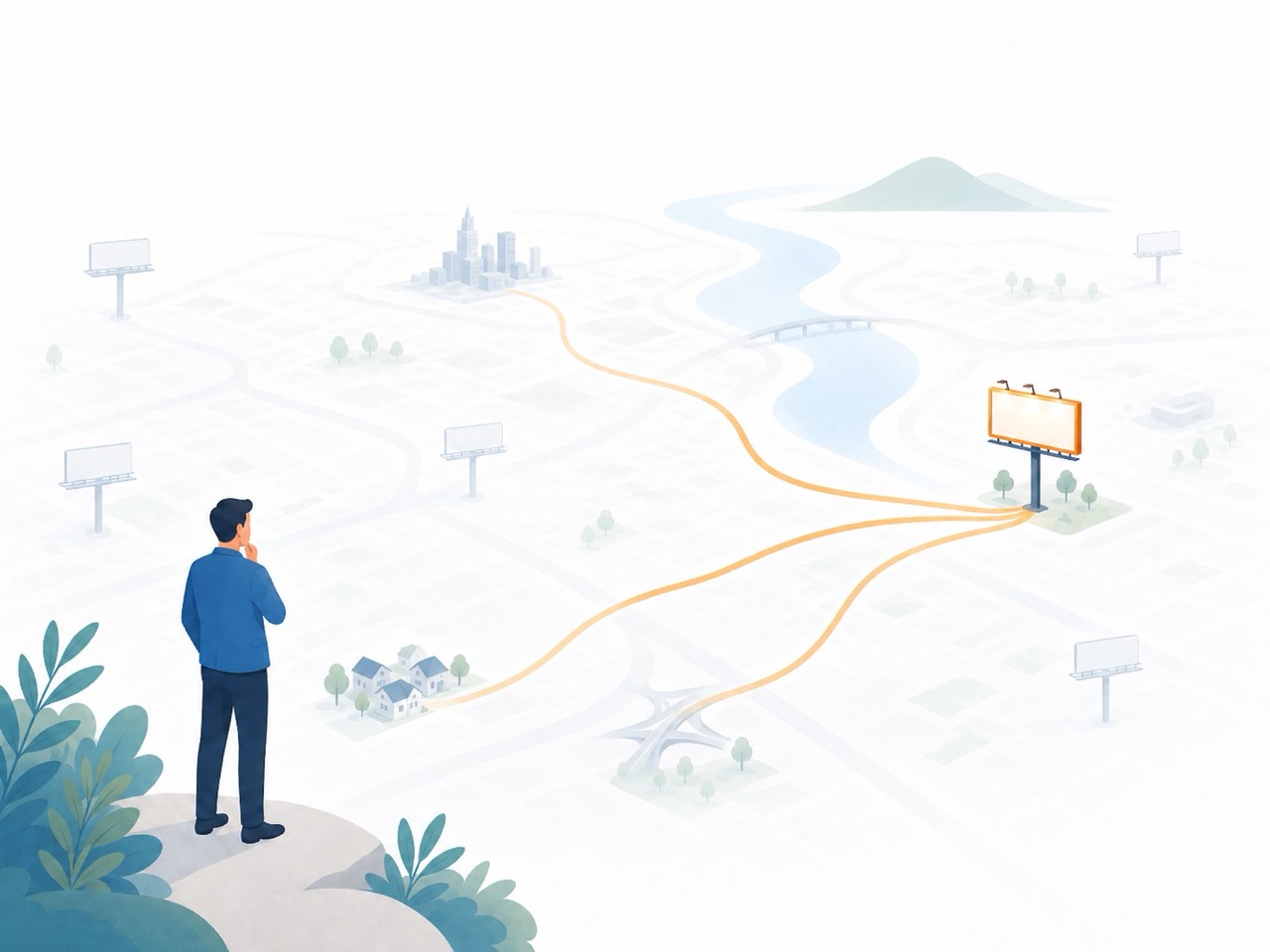
They are asking, “Does this company have locations that fit what I am trying to do?”
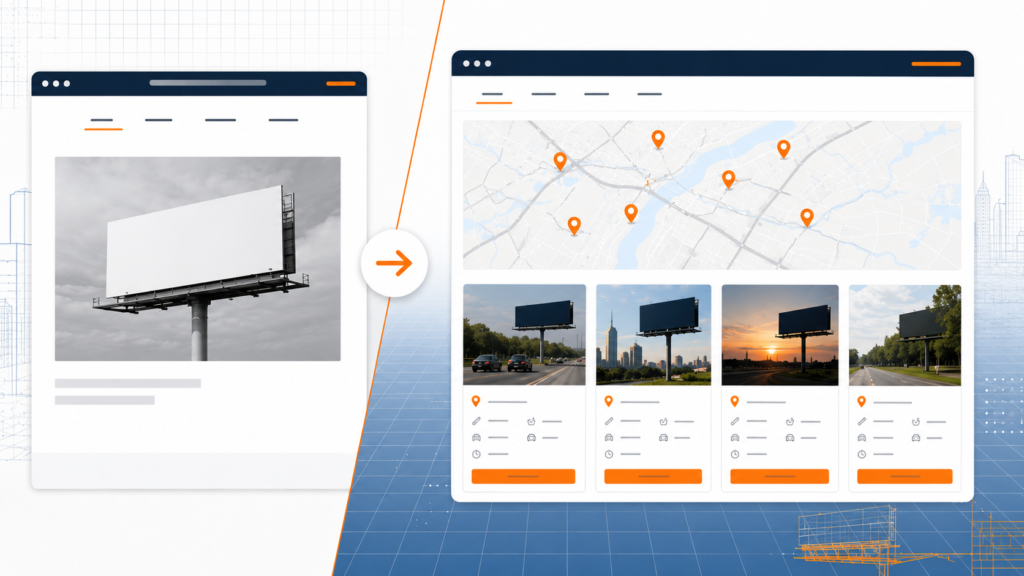
A brochure-style website often makes that answer harder to find than it needs to be. The visitor may see strong photography, a polished homepage, and a contact button, but still have no clear sense of the inventory.
That creates a gap between interest and action.
The advertiser has to call before they understand the basics. The salesperson has to recreate context from scratch. The company may still get the inquiry, but the website has not done much to prepare the conversation.
A stronger billboard website starts earlier. It helps the visitor understand the shape of the inventory before the first call.
The website has to translate how people think
Operators naturally think about inventory in operational terms.
Face IDs. Unit numbers. Static or digital. Vinyl sizes. Illumination. Lease details. Availability. Contract timing. Photos. Install history. Internal notes.
Those details matter inside the business.
Advertisers usually approach the inventory from another direction. They think about cities, highways, neighborhoods, commuter routes, retail areas, landmarks, and the audience they want to reach.
The website has to translate between those two ways of thinking.
A billboard website is not only a place to publish information. It is a place where internal inventory knowledge becomes understandable to an outside buyer.
If someone is interested in billboards in Greenville, they should not have to guess whether Greenville is hidden inside a PDF, a map pin, a gallery image, or a generic “Locations” page. If someone wants inventory along I-40, the website should give them a reasonable path to that information.
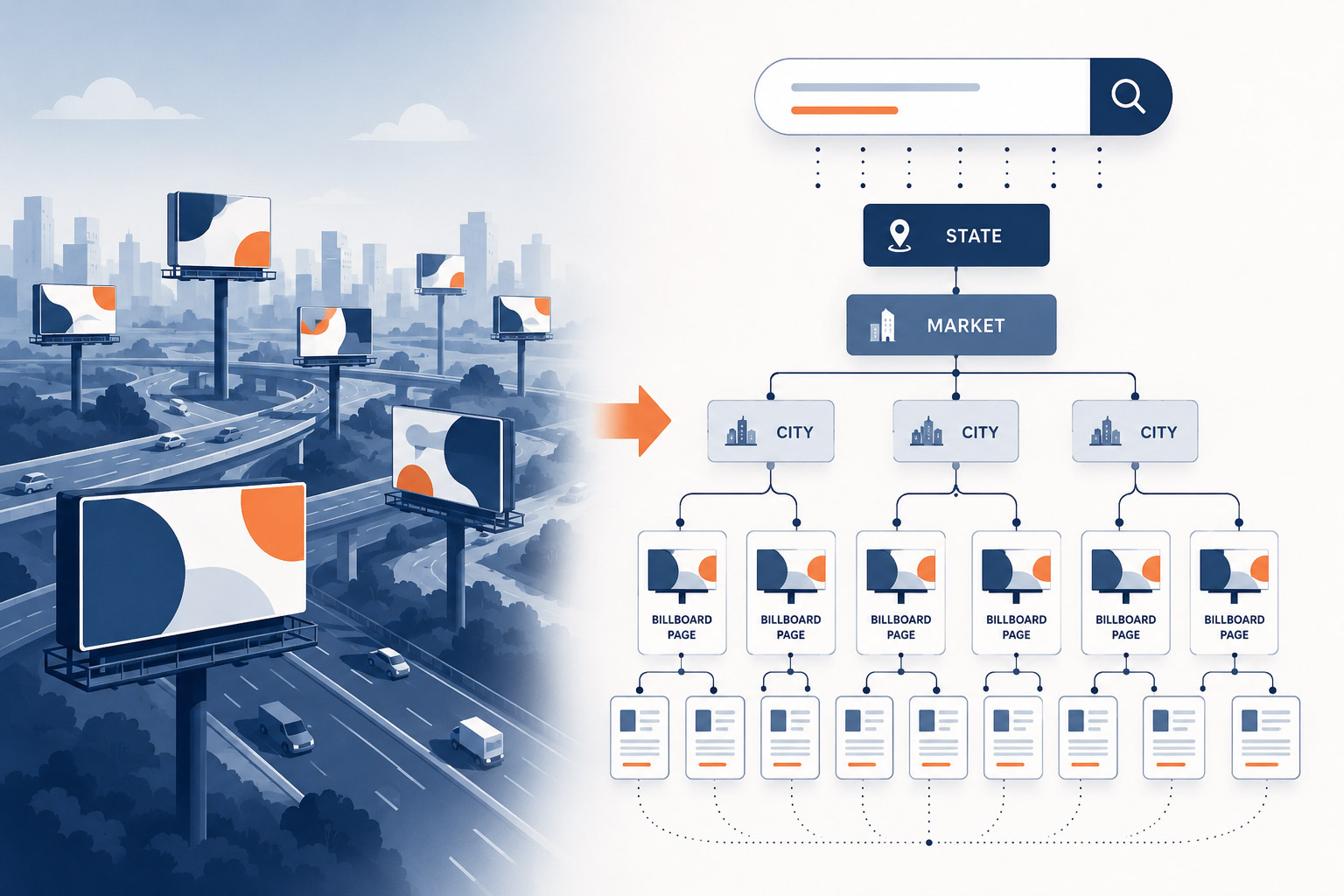
This is where structure begins to matter. A useful billboard website may eventually include market pages, city pages, highway pages, maps, availability views, and individual billboard pages. Not every operator needs all of that on day one. The important point is simpler: the website should reflect how advertisers look for outdoor advertising, not only how the company tracks inventory internally.
The deeper navigation questions deserve their own article. For now, the point is that a billboard website should reduce confusion, not push every buyer into the same generic contact form.
The website keeps working after the sales conversation
One of the clearest tests of a billboard website is what happens after a sales conversation.
A salesperson talks with a local advertiser. The meeting goes well. The advertiser says, “Send me those locations,” or “I’ll look at your website this afternoon.”
What do they see when they get there?
If the website only introduces the company, the salesperson still has to carry the entire inventory conversation manually. They may need to send a PDF, attach photos, explain which boards are nearby, clarify what is available, and answer basic location questions before the advertiser can review the opportunity.
There is nothing wrong with sales support. Billboard sales will always involve conversation, judgment, and follow-up.
But the website should help.
A better website gives the salesperson something specific to send. A city page. A market page. A billboard page. A map view. A current one-sheet. A page with photos, specifications, and an inquiry option tied to that location.
That kind of website supports the conversation instead of restarting it.
It also helps when the advertiser shares the opportunity internally. The owner, marketing manager, agency contact, or franchise partner can review a page that explains the location in context. They are not trying to decode a spreadsheet or remember what was said on a call.
The website becomes part of the sales process, not a separate marketing object.
Search visibility starts with being understandable
Search is not the main point of this first article, but it is one reason the brochure mindset creates problems.
Search engines need understandable pages, links, titles, and content. Google’s own documentation emphasizes clear site structure, descriptive title links, helpful snippets, and crawlable links that allow Google to discover pages across a website.
For billboard operators, the practical lesson is straightforward: if the website does not clearly publish where the inventory is, search engines have less to work with.
A homepage that says “We offer billboard advertising across the region” is not the same as a website with organized pages for states, markets, cities, highways, and individual billboard locations. Those pages give people and search engines more context.
That does not guarantee rankings. It does not guarantee traffic or leads. Search performance depends on many factors, including competition, content quality, authority, technical implementation, and how useful the page is to the visitor.
But a website with clear inventory structure is easier to understand than one that keeps most of the inventory hidden behind a generic contact form or a static PDF.
We will look more closely at this in the next article. For now, the important idea is simple: a billboard website cannot market inventory very well if the inventory is barely visible on the website.
The website and internal systems have different jobs
This is also where operators can get tangled up in software questions too early.
A CRM, inventory system, spreadsheet, or scheduling platform may help manage the business internally. Those tools can be valuable. They may track availability, contracts, pricing, sales activity, proposals, and reporting.
The public website has a different job.
Its job is to help advertisers discover inventory, understand locations, and take the next step.
Those two jobs can work together, but they should not be confused. Internal systems are usually organized around operations. The website should be organized around the buyer’s experience.
That distinction matters because a website built only around internal logic may be technically accurate but difficult for advertisers to use. A location may make perfect sense to the sales team by unit number, but that does not mean a first-time visitor knows where it is, why it matters, or whether it fits their campaign.
A good billboard website respects the operator’s internal workflow while presenting the inventory in public-facing language.
That is one reason OOH Engine approaches billboard websites as inventory publishing systems, not just design projects. The work is not only making the site look better. It is organizing markets, locations, maps, photos, specifications, availability, and inquiry paths so the website can support real sales conversations.
What changes when the website is treated as a sales tool
When a billboard website is treated as a brochure, the homepage carries too much responsibility.
When it is treated as a sales tool, the whole site begins to matter.
The homepage still introduces the company. But the market pages explain where the company operates. The city pages help advertisers narrow their search. The map helps with geography. Billboard pages give individual locations a place to live. Photos and specifications support evaluation. Inquiry forms help the advertiser ask about the location they are actually viewing.
The site becomes more useful because each part has a job.
This does not need to happen all at once. Many operators are working with limited staff, existing spreadsheets, older websites, and practical constraints. The first step is not to rebuild everything overnight.
The first step is to change the question.
Instead of asking, “Does our website look professional?” ask:
“Does our website help someone understand our inventory?”
That question leads to better decisions.
It changes how you think about navigation. It changes how you think about market pages. It changes how you think about maps, photos, availability, and contact forms. It also changes how you evaluate whether the website is helping the sales team or simply existing in the background.
A billboard website should help someone understand your inventory.
For billboard operators, that is the shift everything else builds on.
Next in the Series
In this article, we looked at why a billboard website should do more than introduce the company. For an operator, the inventory is the product, and the website has to help advertisers understand that inventory before the first call, after the sales meeting, and everywhere in between.
But there is another problem beneath the surface.
Even when a billboard company has strong locations, search engines may have very little context about where those locations actually are. In the next article, we’ll look at why Google often does not understand billboard inventory as clearly as operators assume, and what website structure has to do with it.