Website Content, SEO, and Public Inventory
OOH Content Support: Why Billboard Operators Need a Website That Keeps Up With the Business
Most billboard operators know their website should stay current.
Availability changes. New structures are built. Digital displays are added. Install photos need to be replaced. Salespeople need better links to send advertisers. Landowners want to understand who they are dealing with before returning a call.
What has changed is the number of audiences the website now serves. It speaks to advertisers and landowners, but it also provides the public information that search engines and AI search tools use to interpret the company.
That is where OOH Content Support comes in.
It is the ongoing work of researching, writing, publishing, and updating the information that helps an operator’s website remain useful as the business changes.
The goal is not to publish for the sake of publishing. It is to make the website a clearer and more current source of information about the company, its inventory, its markets, and its expertise.
Content is no longer simply a marketing activity. For billboard operators, it has become part of the company’s digital infrastructure.
What is OOH Content Support?
OOH Content Support is an ongoing service that helps billboard operators create, organize, publish, and maintain useful website content.
That may include:
- Educational articles for advertisers.
- Landowner resources about leases, development, and permitting.
- Market, city, highway, state, and regional pages.
- Company news and community updates.
- Frequently asked questions.
- Inventory descriptions and availability content.
- Website updates as markets, photos, services, and locations change.
- SEO content and internal-linking improvements.
- Clear public explanations of the company’s knowledge and experience.
Good content support for billboard operators requires more than general writing ability. It requires an understanding of how billboard companies operate.
Inventory is geographic. Availability changes. Advertisers search by city, market, highway, and location rather than internal unit numbers. Landowners often need education before they understand whether a property may be suitable. Sales teams need accurate pages and current materials they can share.
The operator already has this knowledge. They understand their markets, inventory, advertisers, landowners, permitting challenges, and development process.
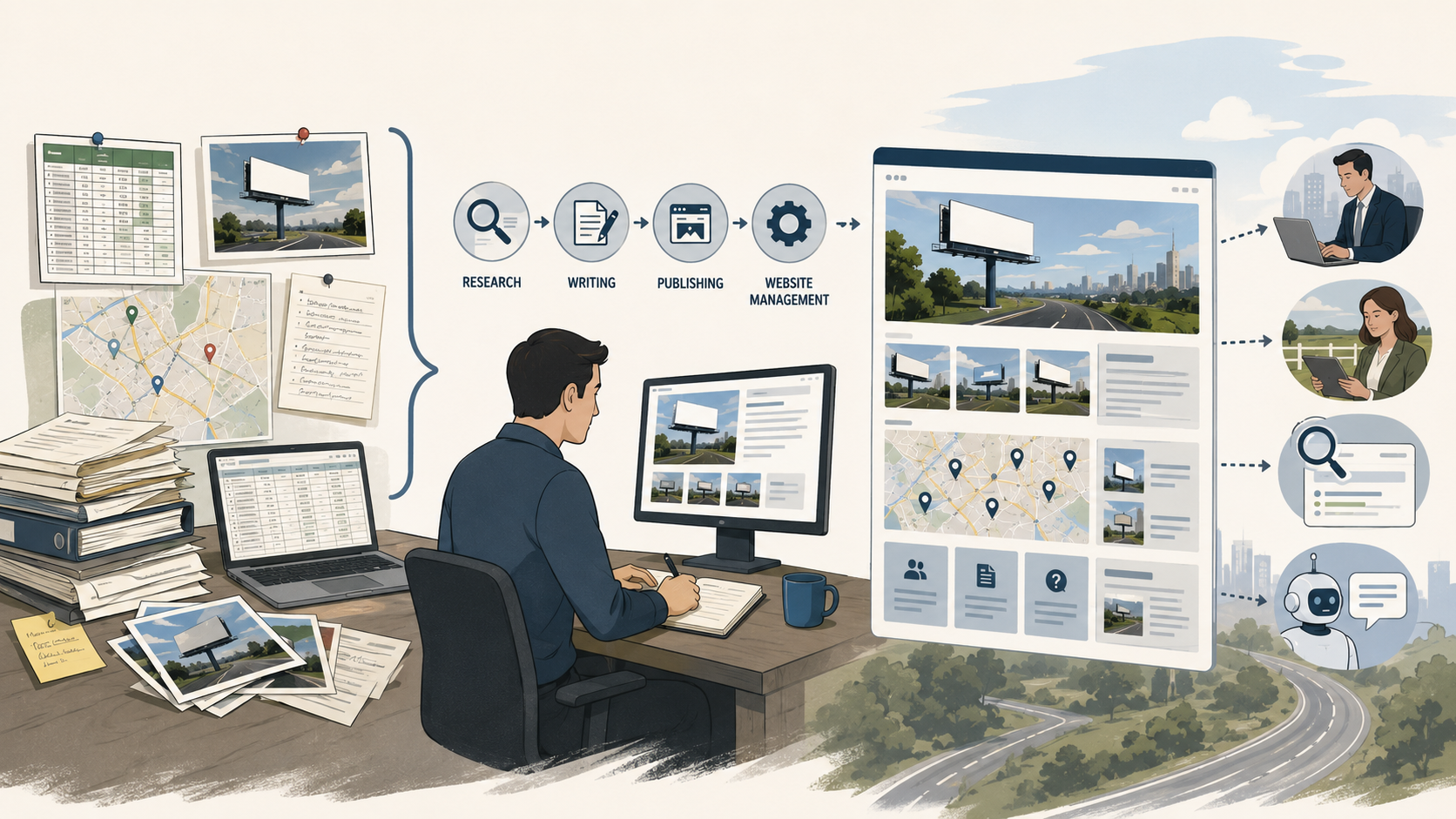
The challenge is turning that knowledge into useful billboard website content consistently.
Internal Operator Knowledge
- Inventory systems and CRM
- Spreadsheets
- Sales team knowledge
- Operations and development experience
- Install photos and availability updates
OOH Content Support
Research, writing, organization, publishing, and ongoing updates
Public Website
- Inventory pages
- Market and city pages
- Landowner resources
- FAQs and educational articles
- Company news
Why billboard websites become outdated
Most billboard websites do not become outdated because the operator does not care.
They become outdated because the business keeps moving.
A new face is added. A digital conversion is completed. A campaign photo comes in from the field. A salesperson notices an old image. A market page needs a better description. A landowner asks how billboard leases work. The answers exist somewhere in the company, but they rarely make it onto the website in a consistent way.
The operator may have spreadsheets, accounting records, sales notes, install photos, inventory documents, and years of local knowledge. The website often sits outside those daily workflows.
That creates a familiar gap: the business changes, while the public website stays the same.
Common signs include:
- Old installation photos.
- Availability pages that are rarely updated.
- Market pages with only a few generic sentences.
- Blog sections that have not been touched in years.
- FAQs that do not reflect current sales questions.
- Landowner pages that request contact information without explaining the process.
- No mention of new structures, digital conversions, market growth, or community involvement.
A website can still look modern and be outdated where it matters most: content, inventory, context, and usefulness.
That affects more than appearance. Advertisers may question whether the inventory is current. Landowners may not understand the company or development process. Search engines have less useful information to evaluate.
Why operators struggle to maintain content
Independent and regional billboard operators usually run lean.
The same people may be involved in sales, leases, operations, construction, creative approvals, posting schedules, billing, local relationships, and vendor coordination. Even when everyone agrees the website needs attention, writing and publishing are easy to postpone.
A useful article requires more than typing. Someone has to choose the topic, understand the reader, organize the explanation, confirm technical claims, add practical examples, publish the page correctly, connect it to related content, and update it later when necessary.
The same is true for market pages, FAQs, company news, and inventory descriptions.
This is why content support for billboard operators is different from general blog writing. Billboard website content has to connect with inventory, geography, sales questions, landowner concerns, website structure, and actual operating conditions.
An article about permitting cannot imply that every market follows the same rules. A page about digital billboards should account for different advertiser needs and local conditions. An availability page must reflect information the sales team can support.
The operator already knows the subject. The difficult part is finding the time and process to publish that knowledge well.
How useful, current content supports SEO
Useful, current content can support SEO. Simply publishing more often does not guarantee better search performance.
Search engines need clear, crawlable pages that answer real questions and explain how information relates. For billboard operators, that means creating pages around the ways advertisers and landowners actually search.
Common searches may include:
- Billboards in a specific city.
- Digital billboards along a highway.
- Outdoor advertising in a regional market.
- Available billboard locations near a commercial district.
- Billboard advertising costs.
- How billboard leases work.
- Whether a property can support a billboard.
A website with only a homepage, contact form, and basic inventory map gives a search engine limited information. It may identify the company but still have difficulty understanding the markets served, inventory types, geographic coverage, development knowledge, and questions the company can answer.
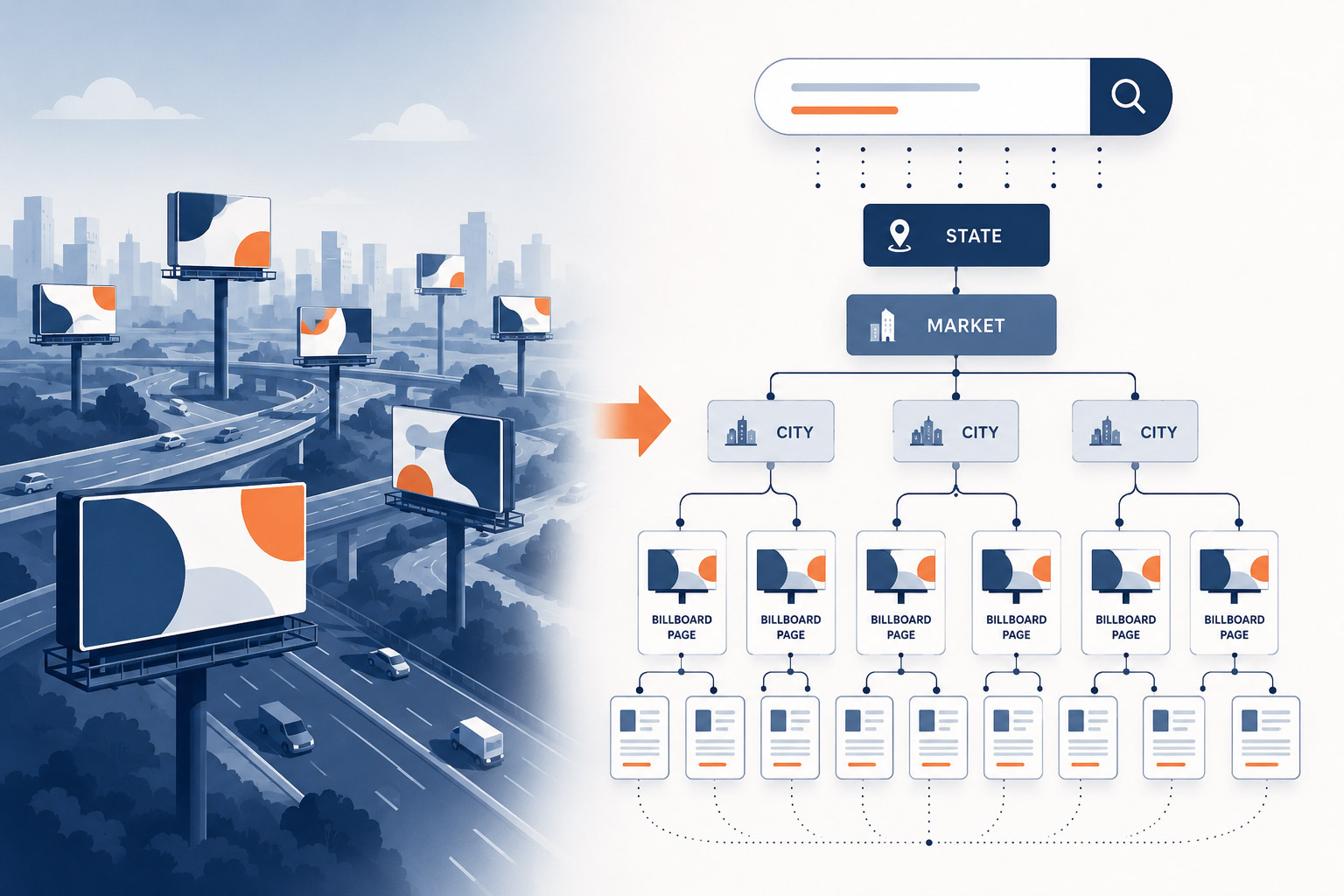
Useful billboard website content creates more ways to explain the business through permanent inventory pages, market pages, availability pages, advertiser education, landowner resources, FAQs, and company updates.
Search engines rank pages, not private spreadsheets or internal databases.
That is why the public website matters. Inventory needs to be presented through readable, organized pages that describe locations in terms advertisers understand.
Good SEO content also depends on structure. Market pages should link to relevant inventory. Billboard pages should link back to markets. Educational articles should point readers toward related locations, FAQs, and services.
The purpose of those links is not simply to influence rankings. They help people navigate the website and help search engines understand how the pages relate.
Why OOH Content Support matters for AI search
AI search tools are changing how people find and summarize information.
An advertiser may ask a search assistant to identify digital billboard options near a highway. A landowner may ask how billboard ground leases work. A local business owner may ask whether out-of-home marketing makes sense for a new location.
These systems rely on public information they can access and interpret. They do not know the operator’s inventory or expertise the way the sales team does.
A search or AI system cannot reliably infer that a particular structure serves commuter traffic unless the website explains the location. It cannot connect the company to a market that is never named. It cannot explain the company’s approach to development if the landowner page contains only a contact form.
Clear website content gives these systems better public information to interpret.
That may include:
- Specific market and city names.
- Highway and directional information.
- Static or digital media type.
- Nearby landmarks and commercial areas.
- Descriptions of advertiser services.
- Landowner and permitting explanations.
- Relationships between market pages and individual billboard pages.
- Current information about the company’s activity and coverage.
No article, schema type, or optimization tactic can guarantee that a company will appear in an AI-generated answer. Search systems weigh many signals, and their interfaces continue to change.
The durable recommendation is simpler: publish useful, accurate, well-organized information that clearly explains the business.
Content that educates advertisers
Advertisers often visit a billboard website with questions they may not ask immediately.
They may want to know how to compare locations, whether to choose static or digital, how far ahead to reserve space, what creative works well, or how to plan across several markets.
A website that only says contact us for availability
makes the advertiser begin from scratch.
Educational articles help them prepare for a better conversation with the sales team.
Useful topics might include:
- How to Choose a Billboard Location for a Local Campaign
- Digital Billboards vs. Static Billboards
- What Makes a Billboard Location Valuable?
- How Billboard Creative Affects a Campaign
- How to Plan an Out-of-Home Campaign Across Several Markets
- What Happens After You Request Availability?
These articles do not need to replace the salesperson. They should support the salesperson.
A representative can send a relevant article after a conversation instead of rewriting the same explanation in every email. The advertiser can then move naturally to market pages, inventory pages, maps, one-sheets, and inquiry forms.
That is practical billboard content marketing: helping the buyer understand enough to take the next step.
Content that educates landowners
Landowner education is often one of the thinnest areas of a billboard website.
Many operators have a page that says they are looking for new locations, followed by a form. That leaves most of the landowner’s questions unanswered.
A property owner may want to understand:
- What makes a site suitable.
- How a billboard ground lease works.
- Why visibility and traffic matter.
- How zoning and permitting affect development.
- What the operator evaluates before making an offer.
- Whether a digital billboard may be possible.
- What happens after the property is submitted.
Clear landowner content makes the process less mysterious.
It can also improve the quality of inquiries. A property owner with frontage along a commercial corridor may understand why a site deserves review. Someone with a property in an unsuitable area may recognize why the opportunity is less likely.
Useful landowner articles could include:
- What Makes a Good Billboard Location?
- How Billboard Ground Leases Work
- Why Permitting Matters in Billboard Development
- Can My Property Support a Digital Billboard?
- What Billboard Operators Look For in a New Site
- What Happens After You Submit a Property?
The strongest landowner content does not make promises. It explains the factors involved and makes clear that every property requires individual review.
The four types of website content operators should keep current
Articles are only one part of OOH Content Support. Four other types of billboard website content deserve regular attention.
1. Market pages
Advertisers usually search by place, not by inventory number.
A market page gives them a practical starting point. It can explain the region, cities served, major highways, available media types, and how to browse the operator’s inventory.
A useful market page may include:
- A clear market description.
- Links to relevant cities, highways, and billboard pages.
- A map or inventory list.
- Static and digital options.
- Availability information or an inquiry path.
- Related advertiser resources.
Market pages also help search engines connect the company to specific geographic areas. They should contain real local context rather than repeating the same paragraph with a different city name.
2. Inventory pages
Every billboard is a physical business asset with a location, direction, dimensions, media type, photographs, and market context.
Availability changes. The location does not.
That is why each face should have a permanent page whenever practical. The page can remain online while availability, current installation photos, and campaign details change.
An effective inventory page may contain:
- Unit or face ID.
- Market and city.
- Highway or road.
- Direction of travel.
- Media type and dimensions.
- Photographs.
- Map and nearby landmarks.
- Current availability when appropriate.
- A downloadable one-sheet.
- A relevant inquiry option.
The CRM can manage inventory internally while the website markets it publicly.
These systems have different jobs. The internal system supports operations. The website helps advertisers discover and evaluate locations.
3. Frequently asked questions
FAQs turn recurring sales and landowner questions into public resources.
Advertiser FAQs might address reservation timing, creative requirements, digital scheduling, design assistance, market coverage, and availability.
Landowner FAQs might explain property review, permitting, site suitability, maintenance, access, and the development process.
Good FAQs use the same plain language people use when asking questions. They should provide a useful answer without oversimplifying issues that require a conversation.
4. Company news
Company news shows that the operator is active.
Useful updates may include:
- New inventory.
- Digital conversions.
- Market expansion.
- Community campaigns.
- New staff.
- Local partnerships.
- Completed projects.
- Improvements to advertiser or landowner services.
These posts do not need to read like formal press releases. A concise, specific update can show advertisers and landowners what the company is doing and connect readers to related market or inventory pages.
Practical examples of OOH Content Support
Helping an advertiser find available inventory
An advertiser searches for digital billboard options near a specific highway.
The operator’s website has a market page for the region, readable inventory pages for the relevant boards, a filtered availability page, and clear links between them.
That structure gives the advertiser several ways to find the inventory. It also gives search systems clearer public information about the geography, media type, and relationship between the pages.
It does not guarantee that the operator will appear in every search result or AI answer. It does make the public information easier to discover and interpret.
Explaining billboard development
A landowner owns property along a commercial corridor and begins researching billboard leases.
The operator has published a page explaining visibility, access, zoning, setbacks, permitting, utilities, and the review process. The landowner understands why a site evaluation is necessary and what information to submit.
The article has answered basic questions before the first call.
Explaining digital billboards
Advertisers and landowners may both ask about digital billboards, but they need different explanations.
An advertiser may need information about campaign scheduling, creative changes, rotation, and market coverage.
A landowner may need to understand that a digital conversion depends on power, visibility, permitting, market demand, and site conditions.
The operator’s knowledge is the same. The content is organized around the reader.
Showing community involvement and company growth
Regional billboard operators are often closely connected to the places they serve.
A website can document nonprofit campaigns, public service messaging, school partnerships, new structures, market expansion, digital upgrades, and completed projects.
Each update shows current activity and gives the company another opportunity to connect its experience to relevant market and inventory pages.
What we do differently at OOH Engine
At OOH Engine, we provide ongoing content support for billboard operators as part of our broader website development and management service .
It is not software.
We do the research, writing, updating, organization, and publishing needed to help the website keep pace with the business.
That support may include:
- Researching useful topics for advertisers and landowners.
- Writing website content in a practical billboard-industry voice.
- Updating pages as inventory, photos, markets, and services change.
- Improving page structure, internal linking, and SEO content.
- Creating clearer public information about markets, inventory, and expertise.
- Helping operators keep the website current without adding another recurring task to the sales team.
The operator already has the knowledge. They understand their markets, inventory, advertisers, landowners, permitting challenges, and development process.
Our job is to help turn that knowledge into useful website content and keep it organized over time.
We believe a billboard website should support the sales process, not simply act as an online brochure. Inventory should be presented around the way advertisers search, while the operator’s internal systems continue managing availability and operations behind the scenes.
The same principle applies to content.
The website should continue explaining the company as the company grows.
FAQ: OOH Content Support for billboard operators
What is OOH Content Support?
OOH Content Support is ongoing help with researching, writing, publishing, organizing, and updating website content for out-of-home media companies. It can include articles, market pages, FAQs, company news, advertiser education, landowner education, and inventory-related updates.
Why does OOH Content Support matter?
A billboard website serves several audiences. Advertisers need help understanding markets and inventory. Landowners need clear information about development and leases. Search engines need organized pages that explain the company and its geographic coverage. Current content helps the website serve all of them more effectively.
Is OOH Content Support the same as SEO?
No. SEO is one part of the service. Content support also includes website updates, educational writing, market information, company news, internal linking, inventory descriptions, and keeping important public information current.
Does publishing more articles improve rankings?
Not automatically. Publishing frequency alone is not a reliable SEO strategy. Articles are useful when they answer real questions, support the website’s structure, and provide accurate information readers can use.
How does content support AI search?
Clear, accessible content gives search and AI systems better public information to interpret. That can include markets, inventory types, highways, advertiser services, landowner resources, and company expertise. It does not guarantee inclusion in an AI-generated answer.
What should billboard operators write about?
Strong topics often come from recurring advertiser and landowner questions. Examples include choosing locations, static versus digital billboards, billboard creative, permitting, site development, market guides, ground leases, company growth, and community involvement.
Why are permanent inventory pages important?
A permanent page gives each billboard a stable public URL. Availability and installation photos can change while the page remains online. That helps advertisers, salespeople, and search engines continue finding the location over time.
Is OOH Engine’s OOH Content Support a software product?
No. It is a service that includes research, writing, website updates, content organization, SEO improvements, and ongoing support.
OOH Content Support helps the website grow with the company
A billboard website has more work to do than display a map and a contact form.
It needs to help advertisers find and evaluate inventory. It needs to answer landowner questions. It needs to explain markets, development experience, company activity, and the operator’s way of working. It should also provide clear public information that search engines and AI systems can interpret.
The operator already possesses the expertise. The challenge is publishing it consistently and keeping it current.
A website should not only showcase your billboard inventory. It should continually demonstrate your expertise to advertisers, landowners, search engines, and AI systems.
When keeping that content current becomes difficult, specialized OOH Content Support can help turn the operator’s knowledge into an organized, useful website that keeps pace with the business.