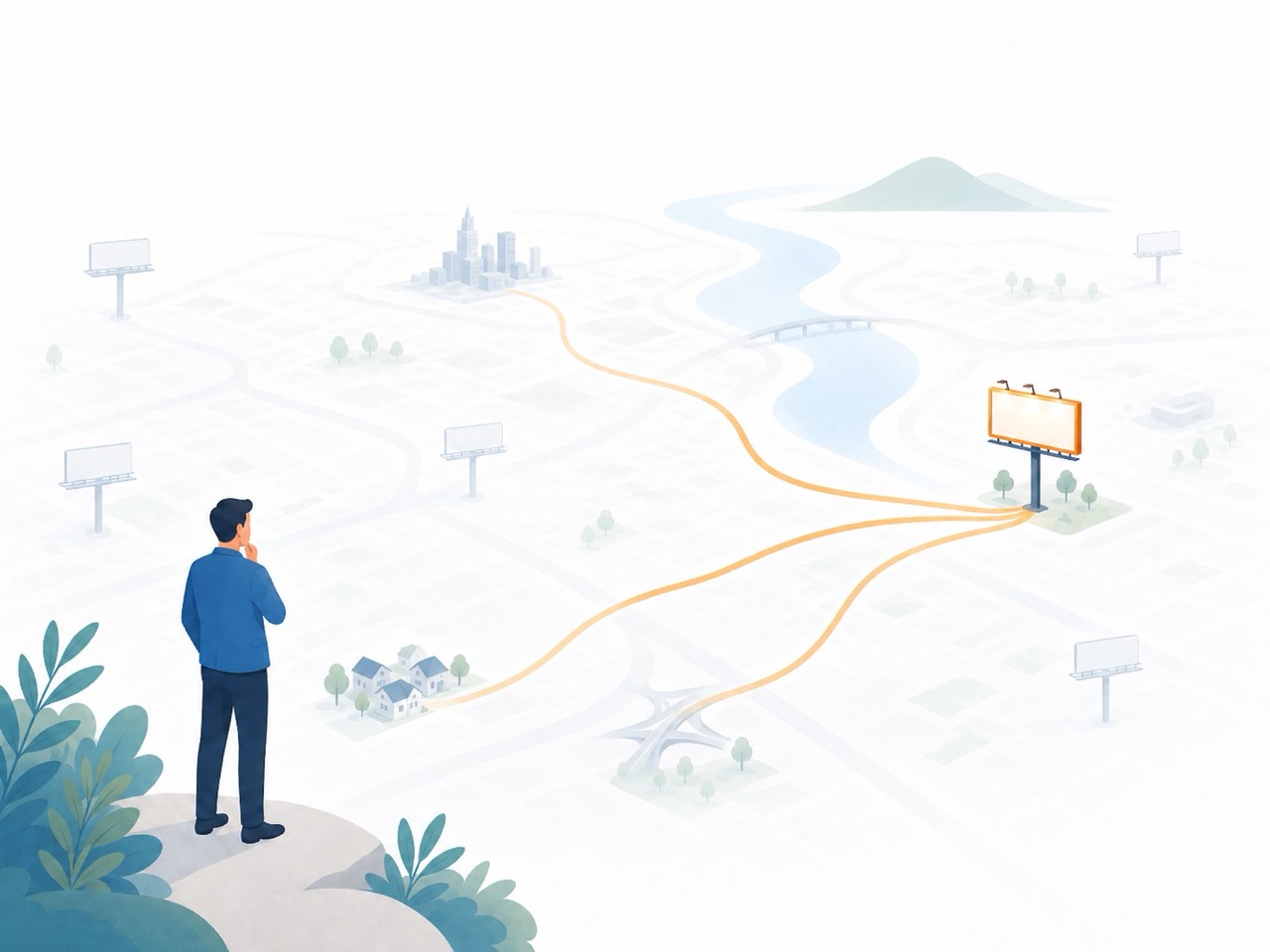
Google’s AI Overview didn’t just find a billboard company in Clayton, NM. It identified a specific available face — inventory ID, dimensions, direction, traffic count, and a contact path — before a visitor ever reached the website.
I recently searched Google for “available billboard in Clayton, NM.”
A regional billboard operator appeared prominently in the results, which was good to see. But the more interesting result was above the standard organic listings.
Google’s AI Overview identified a specific available billboard in Clayton. It listed a 10′ × 30′ east-facing static billboard, Inventory ID NM009. It also included a traffic figure, contact information, and links that allowed the advertiser to learn more or inquire about the location.
This was more than a search result for a billboard company. Google had connected a local buyer’s search with an actual available face.
That raises a practical question for every billboard operator:
When someone searches for available inventory in one of your markets, can Google identify a specific billboard, or can it only identify your company?
Search results and AI-generated answers can change based on timing, location, and updates to the search engine. This article documents what appeared during our test on July 6, 2026, from South Carolina.
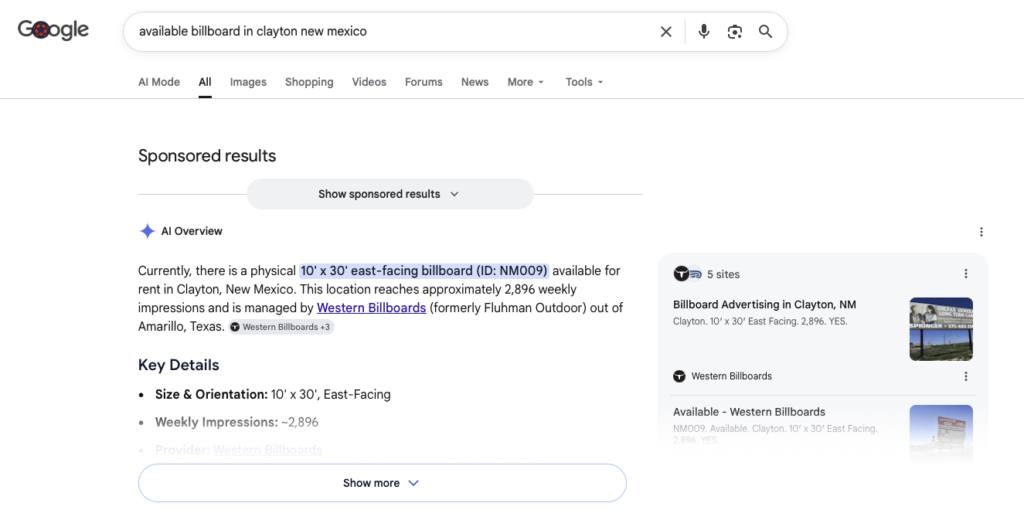
Google’s AI Overview identified the operator’s NM009 inventory record but described the listed daily traffic figure as weekly impressions.
Google Found More Than the Company Name
The AI Overview pulled together many of the details an advertiser would want:
- Clayton, New Mexico
- Inventory ID NM009
- Static format
- 10′ × 30′ dimensions
- East-facing read
- Availability
- A traffic figure
- Contact information
The organic results directly below the overview included the operator’s Clayton market page and its broader available-billboards page.
Google was not simply matching the phrase “billboard advertising” with a company homepage. It had enough information to associate the operator with Clayton and identify a particular face available in that market.
The result does not tell us whether the search produced an inquiry or sale. It does show that the operator’s inventory was discoverable at a more useful level than a general company listing.
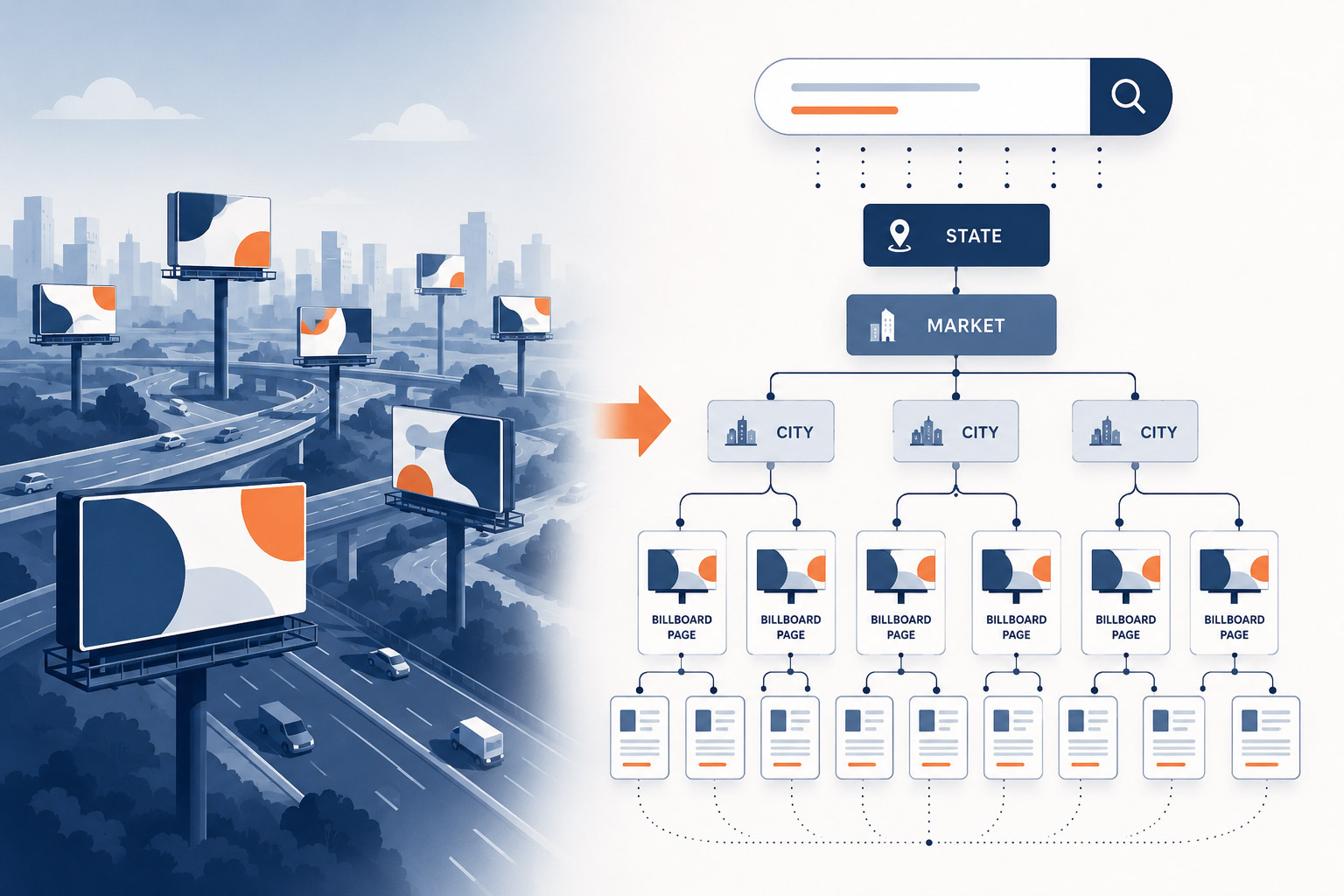
The Two Pages Behind the Answer
The website structure helps explain why Google had enough information to produce the result.
The operator has a page specifically for billboard advertising in Clayton. That page establishes the geographic relationship. It tells search engines and advertisers that the company operates in Clayton and has inventory relevant to that market.
The available-inventory content contains the unit-level details reflected in the answer: the inventory number, size, read direction, traffic, lighting, availability, and contact path.
The city page establishes where the operator works. The billboard record establishes what the operator has there.
Neither page has to carry the entire job by itself. The market page answers the local search, while the inventory record provides information about the specific billboard. That is more useful than relying on a homepage that lists several states or markets without connecting them to individual faces.
Billboard inventory can still be visible to a person without being easy for a search engine to interpret. A visitor may be able to open a map, click a marker, inspect a PDF, or work through an availability tool. That can be a useful browsing experience after the visitor reaches the website.
Search systems have a different task. They need to determine which information belongs to which billboard and how that billboard relates to a city, highway, format, direction, and operator.
The Clayton result gave Google a clear set of relationships. The operator serves Clayton. NM009 is a distinct inventory record. It is a 10′ × 30′ east-facing face with a stated traffic figure, an availability status, and a direct contact path.
The lesson is not that maps, PDFs, JavaScript, iframes, or inventory platforms are inherently bad. Each can serve a useful purpose. The narrower point is that important inventory information is more likely to be discovered and used when it is clearly labeled and published as readable content on the operator’s website.
A map helps visitors browse inventory after they reach the site. Market and billboard pages can help them find the site in the first place.
Google Also Got Part of the Answer Wrong
The result was useful, but it was not perfect.
The operator’s inventory page labels the figure of 2,896 as daily traffic. The AI Overview described it as weekly impressions.
The number appears to have come from the operator’s website, but its meaning changed in the generated answer.
Making information accessible gives an AI system the opportunity to use it. It does not guarantee that the system will interpret every field correctly.
Inventory labels should leave as little room for interpretation as possible. Instead of:
Traffic: 2,896
a page might use:
Average Daily Traffic: 2,896 vehicles per day
Traffic counts and estimated impressions are not interchangeable measurements. Operators may also want to spell out measurement periods, avoid unexplained abbreviations, and identify the source or methodology when appropriate.
Those changes will not prevent every AI error. They provide clearer information for search engines and make the inventory page easier for advertisers, agencies, and salespeople to understand.
The Pricing Estimate Came From Somewhere Else
The AI Overview also included a general estimate for rural billboard pricing in New Mexico. That information came from a third-party source rather than the operator.
Google found specific first-party information about the billboard, then supplemented the answer with a general pricing estimate from another website.
That does not mean billboard operators should publish exact rates. Rates may vary by location, campaign length, production, installation, season, demand, number of faces, and current availability. Many operators reasonably prefer to provide pricing after learning what the advertiser needs.
There may still be value in publishing enough context to guide the answer. A market or inventory page could say:
Rates vary by location, campaign length, production, installation, and current availability. Contact us for confirmed pricing.
That does not disclose private rates. It gives Google and the advertiser a more accurate first-party explanation than a statewide estimate from a marketplace or directory.
The operator controlled the facts published on its own website. It did not control every outside source Google used to complete the answer.
Keep the Billboard Page, Even When Availability Changes
Availability is temporary. The billboard itself is not.
A face may remain in the same market, on the same road, with the same dimensions and direction for years. Its availability can change several times during that period.
Relatively permanent information includes the unit number, location, market, dimensions, read direction, illumination, traffic information, photos, and descriptive notes. Availability, next available date, current campaign, installation photo, and published pricing may change more frequently.
The billboard page should not need to disappear when the face becomes occupied. Its status can change while the permanent record remains online.
That gives the operator a stable page for the asset. It can continue supporting city listings, maps, search results, internal links, inquiry forms, and future availability.
The same record can also support the downloadable one-sheet available from the billboard page. When specifications or installation photos are updated on the website, the sales document can reflect the same maintained information rather than being rebuilt separately.
What the Clayton Result Demonstrates
One search result should not be treated as proof of a permanent ranking or guaranteed business outcome.
The operator appeared prominently in this particular search for available inventory in Clayton. Google identified an actual billboard rather than stopping at the company homepage, and the result appears to have drawn key inventory details from the operator’s own website.
It also showed the limits of the process. Google supplemented that information with a third-party pricing estimate and changed daily traffic into weekly impressions.
Publishing inventory directly does not guarantee that every search system will interpret it correctly. It gives the operator a stronger first-party source that can be discovered, checked, and improved.
Try the Same Search in Your Markets
Operators can run a similar test in a few minutes.
Search for:
- available billboard in [city, state]
- billboard advertising in [city, state]
- digital billboard in [city, state]
- billboard on [highway]
- [company name] billboards in [city]
- [unit number] billboard
Then look closely at what appears.
Does your own website show up? Can Google identify a specific face? Is the availability current? Are the dimensions, traffic, and direction labeled correctly? Is Google using your website as a source, or filling the answer with information from brokers, marketplaces, and directories?
Check whether the correct phone number appears and whether the individual billboard can be opened directly. Look for occupied boards that are still shown as available, outdated photos, or traffic figures that have been mislabeled.
Save screenshots and repeat the test periodically. Search results and AI-generated answers change.
Run a few of these searches in the markets you serve and see what Google finds. The results may show that your inventory is well represented, or they may reveal outdated listings, missing pages, unclear specifications, or information being pulled from third-party sources.
OOH Engine works as a digital teammate for independent and regional billboard operators, helping organize and publish inventory directly on the operator’s website while keeping photos, availability, market pages, downloadable one-sheets, and other website content current. We also manage ongoing updates, mobile browsing, and website support so the operator does not have to handle everything internally.
Learn more about how OOH Engine helps operators keep their website inventory current, or talk with us about how your existing site is presenting your boards.