A billboard website rarely fails all at once.
More often, the problems show up quietly. A salesperson has to dig through old folders for a photo. An advertiser asks for information that should already be easy to find. A landowner looks you up, but the site doesn’t really show the kind of company you’ve built.
None of those things feel like a crisis in the moment.
But over time, they create drag.
That’s usually how operators discover their website is holding them back. Not because the site is broken. Because the business has moved forward and the website hasn’t moved with it.
1. Advertisers Keep Asking Questions the Website Should Already Answer
Every billboard company gets questions from advertisers. That’s part of the business.
The problem is when too many conversations start from zero.
Where are your boards located? Do you have anything near this highway? Are those static or digital faces? Can you send photos? What markets do you cover?
Those are fair questions. But if your team has to answer them manually every time, your website isn’t doing enough of the early work.
Advertisers today often research inventory before reaching out. Organizations like Geopath have helped establish common standards for audience measurement and location evaluation across the out-of-home industry, which means many buyers expect to review locations, markets, and coverage online before starting a conversation.
A good billboard website doesn’t replace the sales conversation. It improves it. By the time an advertiser reaches out, they should already have a basic understanding of where you operate, what kind of inventory you have, and whether your locations are worth exploring further.
2. Your Sales Process Still Depends on PDFs, Folders, and Manual Follow-Up
Most operators have some version of this system.
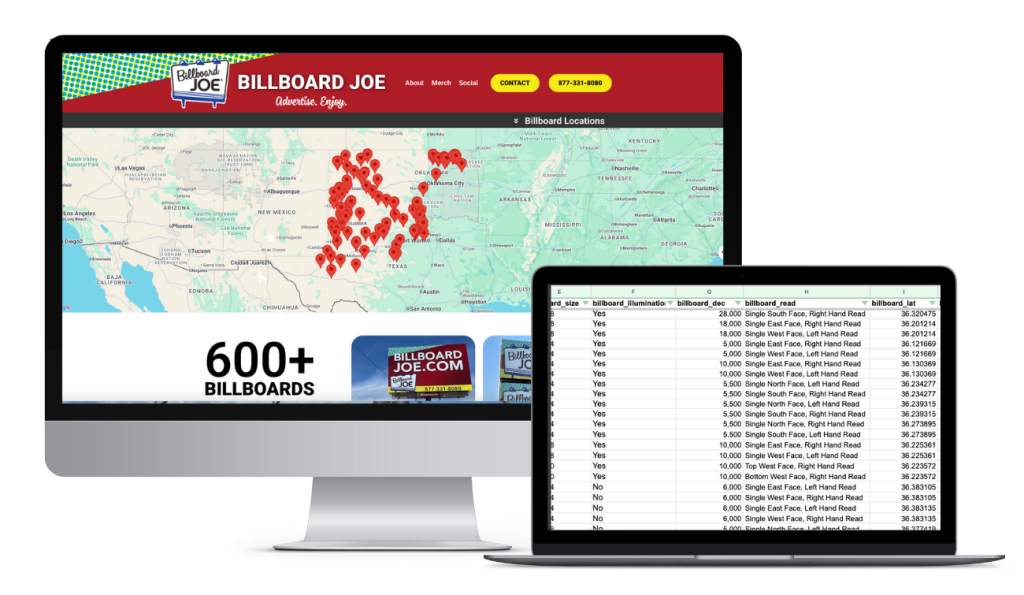
A spreadsheet with inventory. A folder of board photos. A handful of PDFs. Maybe a few one-sheets that get reused and edited as needed.
There’s nothing wrong with that at first. It works when inventory is small and the same people know where everything lives.
But as the company grows, that system starts to show its limits. Someone has to find the right photos. Someone has to make sure the location information is current. Someone has to build the same basic package for the tenth time that month.
One operator we worked with had reached the point where the website wasn’t really part of the sales process at all. The team still relied on manual files because the site wasn’t easy to update or useful enough to send to advertisers. The website existed, but the real work was happening around it.
That’s usually a sign the business has outgrown the site.
3. New Inventory Takes Too Long to Get Online
Growing operators add faces.
That sounds obvious, but it creates a practical website problem: every new structure needs to be presented somewhere.
If adding a new billboard means waiting on a developer, editing a static page, rebuilding a gallery, or manually creating a new PDF before anyone can show it properly, the website becomes a bottleneck.
Eventually, teams stop updating it as often as they should.
And once that happens, the website slowly becomes less trustworthy. Not because anyone meant for it to happen, but because the process is too difficult to keep up with the pace of the operation.
A billboard website should make new inventory easier to publish, not harder.
4. The Site No Longer Reflects the Company You’ve Built
This one is easy to overlook because it happens gradually.
Maybe the website was fine when it launched. It had a few market pages, some contact information, and enough credibility to get by.
Then the company grew.
More faces. More markets. Better structures. Stronger advertiser relationships. More professional operations behind the scenes.
But the billboard website still looks like the old version of the company.
That mismatch matters. Advertisers, landowners, and potential partners often form an opinion before they ever talk to you. If the site makes the operation look smaller, less organized, or less current than it really is, you’re starting that conversation at a disadvantage.
The website doesn’t need to exaggerate the business. It just needs to match it.
5. Landowners Don’t Have a Clear Reason to Reach Out
Most billboard websites are written for advertisers.
That makes sense, but it leaves out another important audience: landowners.
If a property owner has land along a strong corridor, near a busy intersection, or in a market where you want to grow, they may look you up before responding to a call or submitting a property inquiry.
What do they see?
Do they see a serious outdoor operator with real inventory, clear markets, and a simple way to start a conversation? Or do they see a thin website that barely explains the company?
Landowner opportunities are easy to underestimate because they don’t always show up as obvious website leads. Sometimes the website’s job is simply to create enough confidence for the next conversation to happen.
6. Your Billboard Photos Are Outdated, Inconsistent, or Hard to Find
Photos do more work than most operators realize.
To an advertiser, the photo is often the first real proof of the location. It shows the approach, the structure, the visibility, the surroundings, and the quality of the face.
When the billboard website photos are outdated or inconsistent, inventory feels harder to trust.
This can create internal problems too. One operator we’ve worked with keeps current install photos tied closely to individual structure pages. Over time, that became useful beyond sales. When something didn’t match in paperwork or internal records, the website sometimes served as a quick visual reference for what was actually in the field.
That’s not the kind of benefit most people think about when they hear “billboard website.” But it’s real.
A well-maintained website can become more than a marketing asset. It can become a lightweight inventory reference that helps the team stay aligned.
7. The Website Looks Fine, but It Doesn’t Reduce Any Work
This is the quietest sign.
The site may look decent. It may load quickly. It may have your logo, phone number, and a few nice photos.
But does it actually help?
Does it reduce repetitive questions? Does it make inventory easier to present? Does it help advertisers understand your markets? Does it give landowners a clear next step? Does it support the sales team?
If not, the website may be more of a brochure than a business tool.
That’s not always a problem for a very small operator. But once inventory grows, markets expand, or inbound inquiries become more valuable, a brochure-style website starts to feel thin.
The Real Warning Sign: Your Team Works Around the Website
If there’s one pattern that shows up again and again, it’s this: the team stops trusting the billboard website.
They don’t send advertisers there because the information is outdated. They don’t update it because the process is frustrating. They don’t rely on it because the real inventory picture lives somewhere else.
So the website becomes separate from the operation.
That’s usually the clearest sign it’s holding the business back.
When Should an Operator Fix It?
Not every billboard website problem requires a full rebuild.
Sometimes the answer is better photos. Sometimes it’s clearer market pages. Sometimes it’s a better inquiry form or a cleaner way to organize inventory.
But if the same issues keep showing up — outdated inventory, manual sales materials, poor location presentation, or repeated advertiser questions — it’s worth taking seriously.
Especially if the company is growing.
Growth has a way of exposing website problems that were easy to ignore before. What worked at 20 faces may not work at 75. What worked at 75 may become a real constraint at 150.
If you’re still trying to determine whether your operation has reached that point, our article on how many faces you need before a billboard website matters may be a useful starting point.
A Practical Takeaway
Your billboard website should make the business easier to understand and easier to work with.
For advertisers, that means clear inventory, markets, photos, and next steps. For landowners, it means credibility and a simple path to reach out. For your team, it means less time recreating the same information manually.
If your website is not doing any of that, it may still be online — but it is not really working.
And for a growing operator, that difference matters.